
The phrase “knuckle sandwich” probably wasn’t invented with healthy eating in mind. Still, your hands can come in surprisingly handy when you want a quick sense of how much food is on your plate.
Whether you’re at a work lunch, grabbing a bite with friends, or eating on the go, you may not have measuring cups or a kitchen scale. Your hand offers a portable alternative: a simple visual guide to portions, without the extra equipment.
Think of these comparisons as rough estimates, not rules about how much you should eat. Hand sizes, food shapes, and individual nutrition needs all vary. Here’s how to use the method.
Let your hand be your guide.
Protein: use your palm. A palm-sized portion of cooked meat, fish, or poultry (excluding your fingers) is roughly 3 ounces. Thickness matters, so treat this as a visual estimate rather than an exact weight.
Vegetables and fruit: use your fist. A closed fist is a useful reference for about 1 cup of raw vegetables or fruit. Include a colorful variety, and remember that different foods pack together differently.
Grains and other starches: cup your hand. One cupped hand gives a rough idea of ½ cup of cooked rice, pasta, or similar foods. It’s a convenient way to visualize the amount, not a universal serving recommendation.
Nut butter and dressing: look at your thumb. A thumb-sized amount can help you picture a small portion—roughly 2 tablespoons in one commonly used guide. Because thumbs vary, check yours against a measuring spoon at home if you want a more useful personal reference.
Butter and similar spreads: look at your thumbnail. A thumbnail-sized amount is roughly 1 teaspoon. But for liquid oils, a measuring spoon is still more reliable than guessing a fingertip-sized pour.
Dairy: match the guide to the food. Your fist can help you visualize about 1 cup of milk. Cheese is harder to judge by a single finger because its shape and thickness vary; use the package’s serving information or a scale when accuracy matters.
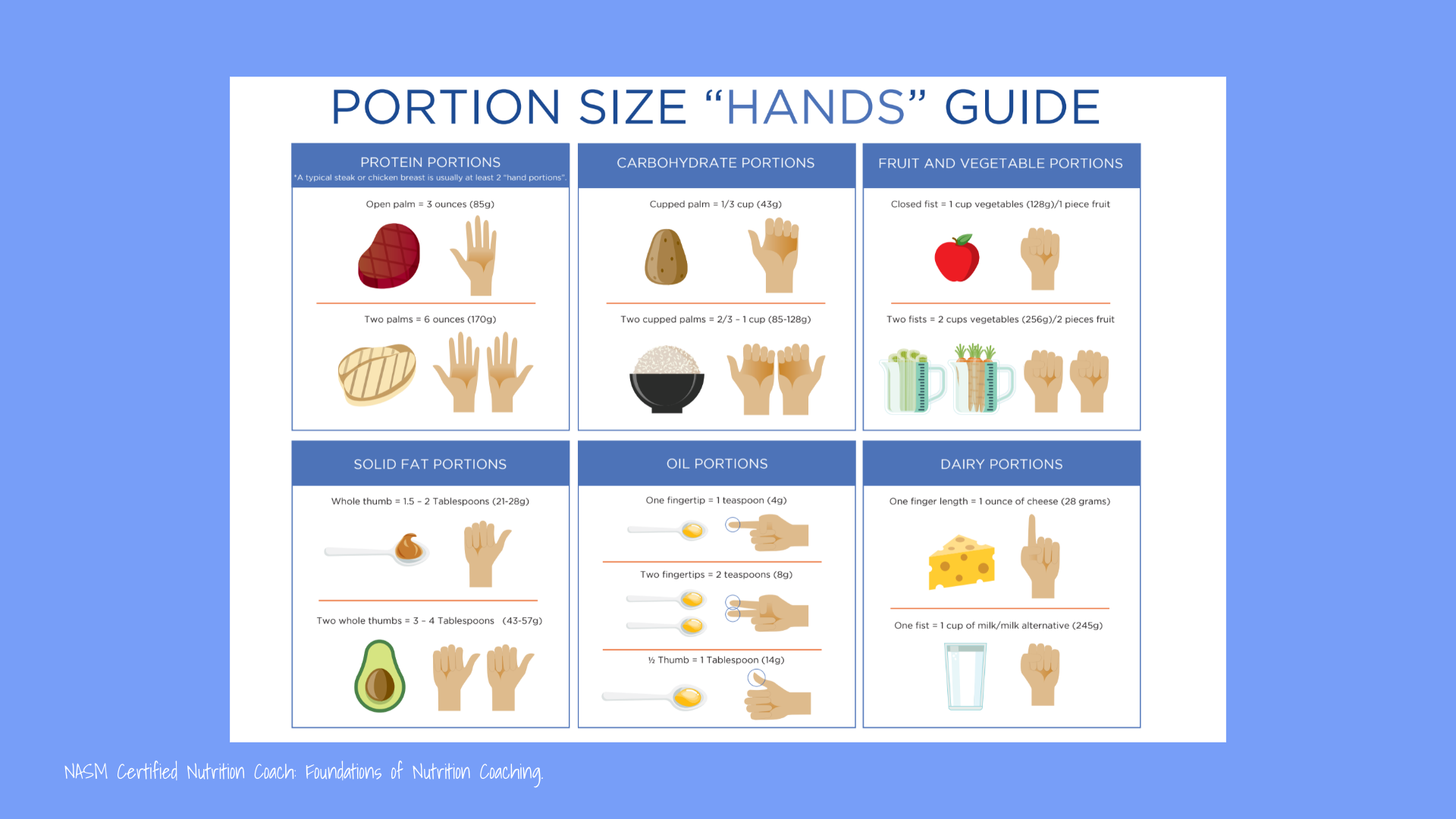
The value of this method is convenience, not precision. A portion is the amount you choose to eat; it doesn’t have to match a serving listed on a food label. Your needs may change with your activity level, appetite, and health circumstances. If you follow a prescribed eating plan, use that guidance rather than relying on hand estimates alone.
Try these comparisons the next time you’re eating away from home. Notice what your usual portions look like, enjoy your meal, and pay attention to whether you feel comfortably satisfied afterward. You don’t need to measure every bite—sometimes, a little awareness is the most useful tool you can bring to the table.
Resources:
"Your Handy Guide to Portion Sizes." Human Performance Resources by CHAMP, Uniformed Services University, 10 Apr. 2019, www.hprc-online.org/nutrition/performance-nutrition/your-handy-guide-portion-sizes.
National Academy of Sports Medicine. NASM Certified Nutrition Coach: Foundations of Nutrition Coaching. National Academy of Sports Medicine, 2026. NASM, https://www.nasm.org/products/certified-nutrition-coach.